

How a European Union-funded, UNDP-delivered EV laboratory at Orange Walk ITVET is turning Belize’s climate ambitions into a operational, homegrown workforce — and why Labtech International was chosen as the technical partner to make it happen
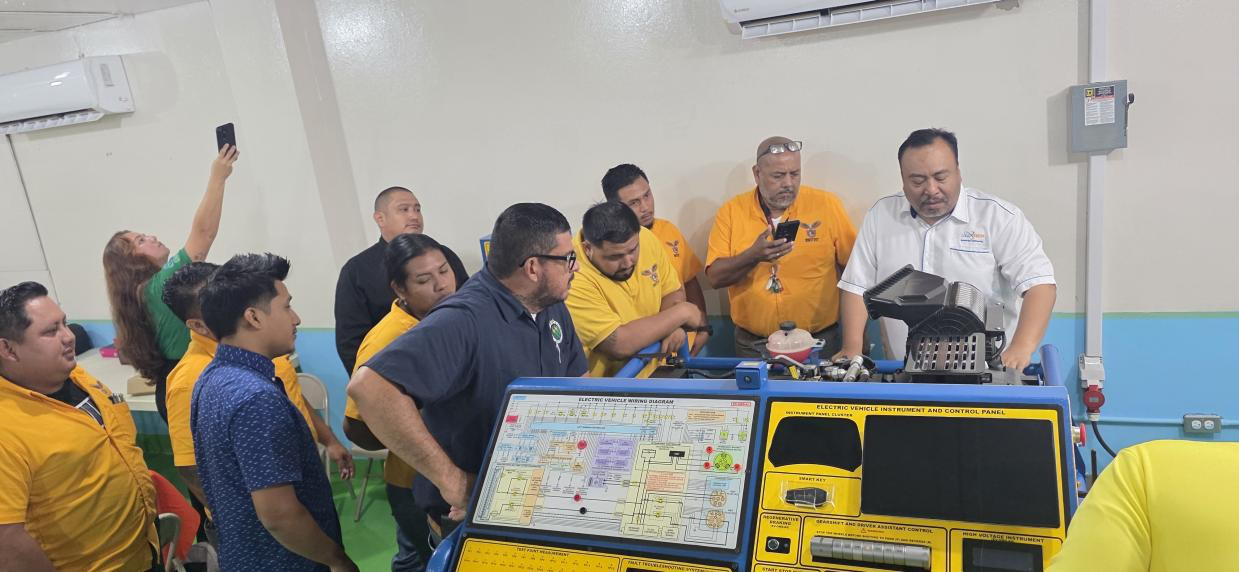
The full training cohort at Orange Walk ITVET, alongside UNDP Belize and Labtech International, following the Training of Trainers programme.
On 8 July 2026, in a converted classroom in Orange Walk, Belize, government officials, European Union representatives, and United Nations Development Programme (UNDP) leadership gathered to cut a ribbon on something the region had never seen before: a fully equipped Electric Vehicle laboratory, purpose-built to train the technicians who will keep the Caribbean’s electric future on the road.
It was the culmination of a project financed by the European Union and delivered through UNDP Belize — and of a ten-day installation and training mission by Labtech International that transformed an unfinished room, midrenovation, into a fully certified training facility in barely a week and a half. This is the story of how it happened, why it matters far beyond Orange Walk, and what it signals about the road ahead for e-mobility training across the Caribbean and Central America.

Orange Walk ITVET’s campus, home to the region’s first EV laboratory.
The Missing Link in the Region’s Green Transition
Across the Caribbean and Central America, governments are moving decisively toward low-carbon transportation. Belize itself already operates five electric buses on its roads, part of a broader national commitment to reduce transport emissions. Electric vehicle charging infrastructure is being rolled out by utilities such as Belize Electricity Limited. Curricula have been developed. Policy commitments have been made. But a critical gap remained: qualified technicians. Vehicles and charging stations can be imported, installed, and switched on — but without technicians trained to install, diagnose, and maintain them safely, a national EV strategy is a fleet without a future. Automotive mechanics accustomed to internal combustion engines, electricians used to conventional wiring, and TVET instructors teaching from static diagrams all shared the same limitation: theoretical familiarity with EV technology, but no hands-on platform to build real, certifiable competency.
“All participants arrived with strong common knowledge on the topic — but were missing the key piece: real training systems.”
This is precisely the gap the European Union, UNDP Belize, and the Orange Walk Institute of Technical Vocational Education and Training (OWITVET) set out to close — and the gap Labtech International was brought in to fill.
A Regional First, Years in the Making
The Orange Walk EV Laboratory did not appear overnight. It builds directly on earlier European Union and UNDP support that helped Belize’s Ministry of Education, Culture, Science and Technology develop the country’s first EV curriculum in 2024. That curriculum gave instructors a syllabus; what it still needed was equipment capable of turning theory into hands-on, certifiable skill.
The laboratory now installed at OWITVET is funded by the European Union as part of its Global Gateway strategy and delivered through UNDP Belize in partnership with Orange Walk ITVET and the Ministry of Education, Culture, Science and Technology. Confirmed by UNDP and the European Union at the official inauguration ceremony as one of the most advanced EV laboratories in the Caribbean, it is recognised as the first Electric Vehicle laboratory in the Caribbean and Central America region — a genuine regional milestone, not just a national one.
For a small nation like Belize to be first in the region on a technology frontier like this is a significant statement of intent — and a signal to neighbouring countries that the infrastructure to train, certify, and deploy EV technicians at scale now exists as a proven model, not a theoretical one.
Ten Days: From Unfinished Room to Regional Milestone
When the Labtech International team — Technical Training Specialist Arnaud Delvaux and Training Engineer Izzu Zulkifly— arrived in Belize at the end of June 2026, the room designated for the new laboratory was still, quite literally, under construction. Electrical points were being wired. Walls and floors were being painted in temperatures exceeding 40°C. The two split air-conditioning units required for the equipment’s operation had yet to be installed. And in a detail that speaks to the practical realities of any first-of-its-kind installation, the existing doorways proved too narrow for the laboratory’s main trainer unit to pass through — requiring a wall to be broken down and a door widened on the spot.
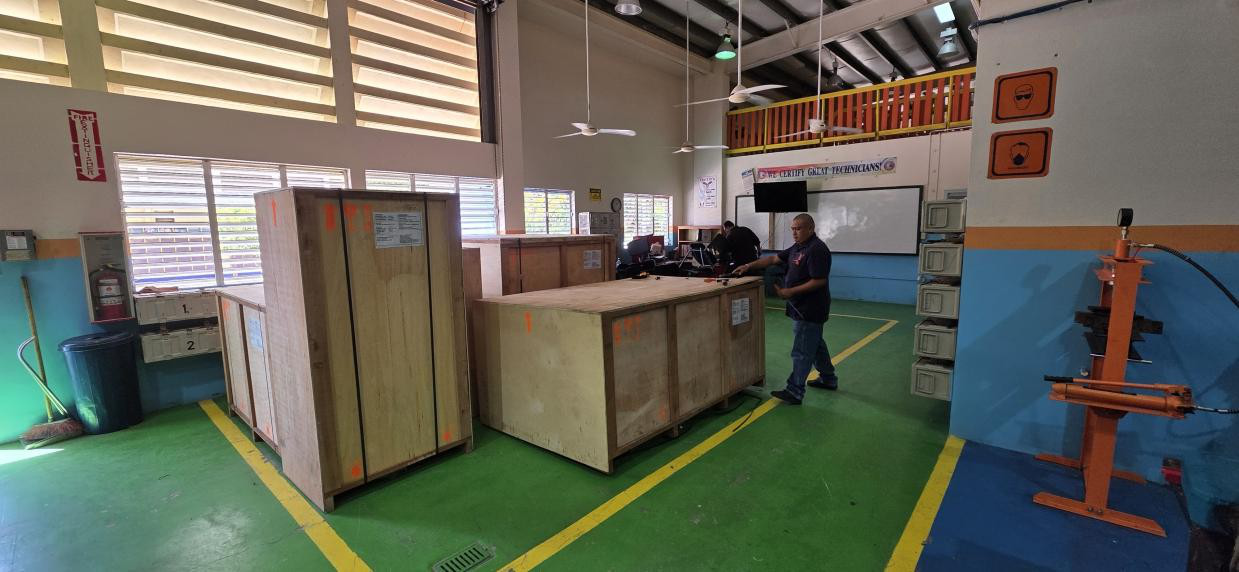
A doorway is widened on site to allow the main EV trainer through — one of several practical challenges resolved during the
installation week.
Despite these obstacles, the Labtech team unboxed, assembled, wired, and commissioned a full suite of specialised EV training equipment within days: an Electric Vehicle Battery Pack Trainer, an Operable Electric Vehicle Machine (Motor) Test Bed, an Electric Vehicle Charging Station Trainer, and an Electric Vehicle System Simulator, complete with instrument panels, load simulators, and diagnostic tools. Every unit was functionally tested before training began — including resolving a last-minute requirement for three-phase power supply on the motor test bed, completed and verified the Saturday before training was due to start.
By the following Monday morning, a fully operational, professionally finished EV laboratory — repainted, airconditioned, rewired, and equipped — was ready to receive its first class.
More Than Equipment: A Training That Changed Minds
What distinguished this project was not only the speed of installation, but the breadth of who came to learn. Rather than limiting the Training of Trainers programme to ITVET instructors alone, UNDP Belize deliberately invited a cross-section of the country’s emerging EV ecosystem: automotive instructors and students, an English and IT instructor, and — notably — engineers, fleet supervisors, and technicians from Belize Electricity Limited, the utility responsible for the national rollout of EV charging infrastructure.
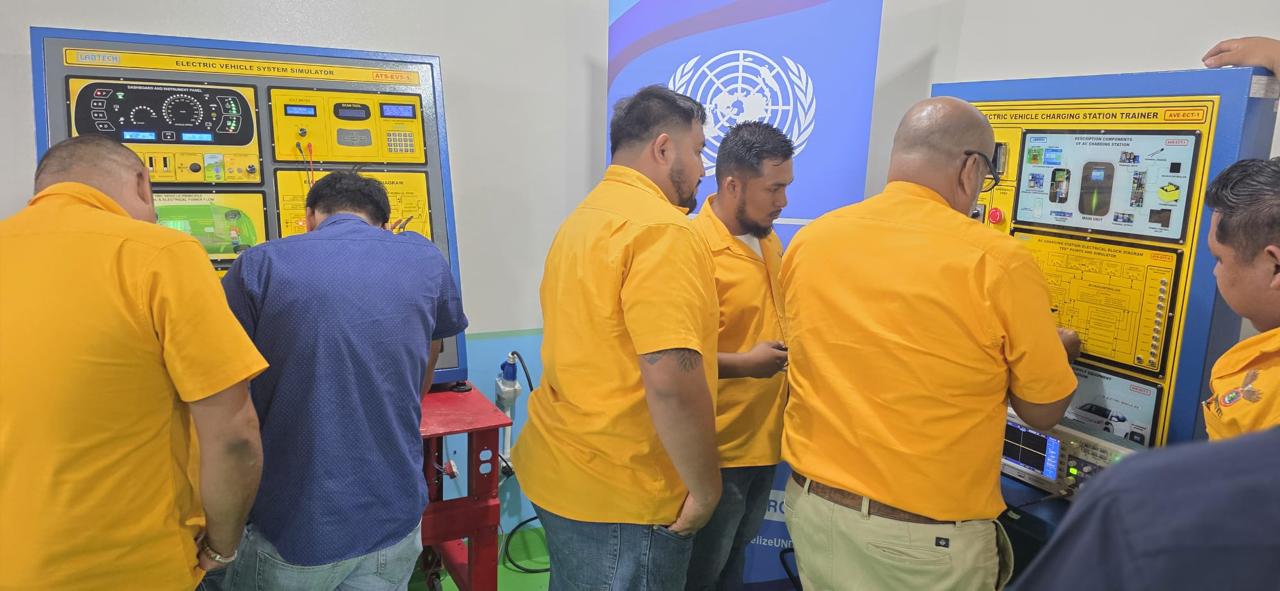
Hands-on instruction during the Training of Trainers programme.
Sixteen participants in total spent two intensive days with the new equipment: a morning of structured theory followed by afternoons of genuine, hands-on practice on every trainer, ensuring the group could operate the equipment independently before the Labtech team departed. By the second day, the team returned to recap and consolidate the full range of units, and every participant received a formal training certificate.
“Combining TVET instructors with electrical professionals installing the public charging stations, and automotive professionals maintaining Belize’s electric buses, has been a great experience for everyone — they all had common knowledge on the topic, but were missing the key piece: the Labtech training systems.”
The feedback that followed captured exactly why hands-on training matters. Felipe, OWITVET’s automotive instructor, offered strong, positive feedback on the programme. A participant from the electrical industry — accustomed to working with EV infrastructure from the outside — remarked on how valuable it was to finally see, feel, and touch the internal components of an electric vehicle, giving him a far deeper understanding of its mechanics and operation than any manual or diagram could provide.
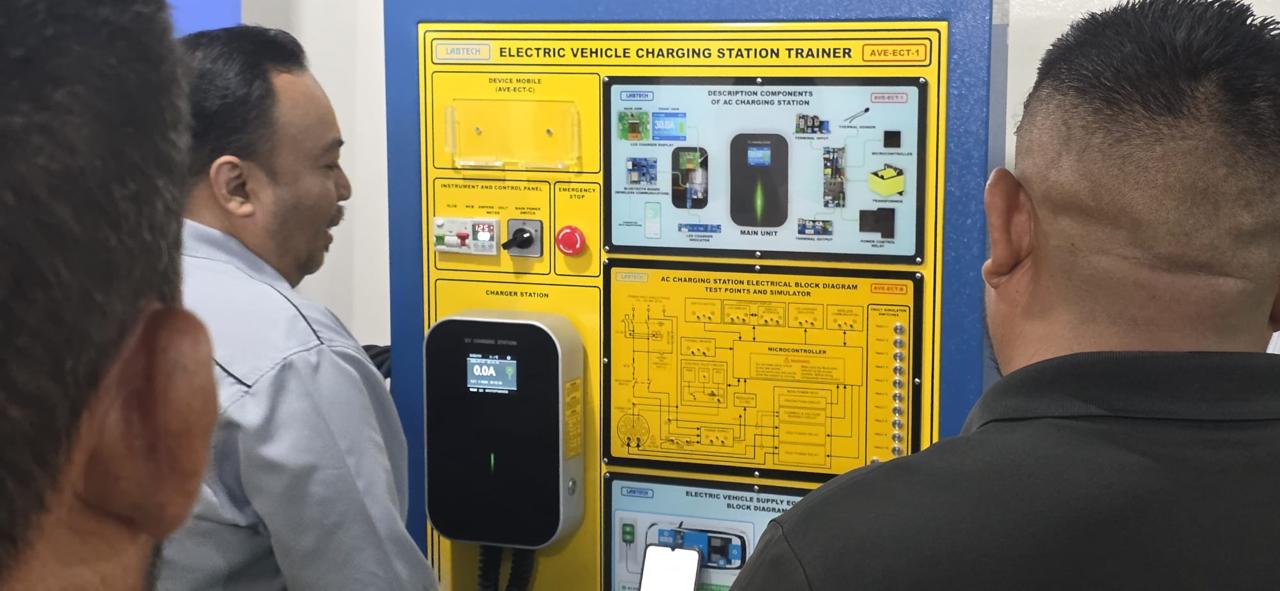
Participants gather around the Electric Vehicle Charging Station Trainer, working through the AC charging station’s block diagram and test points.
Labtech International: The Strategic Partner Behind the Milestone
For more than 40 years, Labtech International has designed and delivered technical and vocational training equipment and curricula to more than 100 countries, working consistently alongside institutions such as UNDP, UNIDO, and the World Bank on technology-forward TVET programmes. The Belize project reflects exactly the model Labtech brings to every engagement: not simply the supply of equipment, but full-cycle delivery — installation, commissioning, structured Training of Trainers, and certification — completed on the ground, on schedule, and adapted to real site conditions as they arise.
In Belize, that meant a two-person Labtech team solving civil works issues, commissioning four distinct categories of specialised EV training equipment, and training a sixteen-person, four-institution cohort to independent competency — all within a single ten-day mission, and all culminating in a nationally and regionally significant public inauguration.
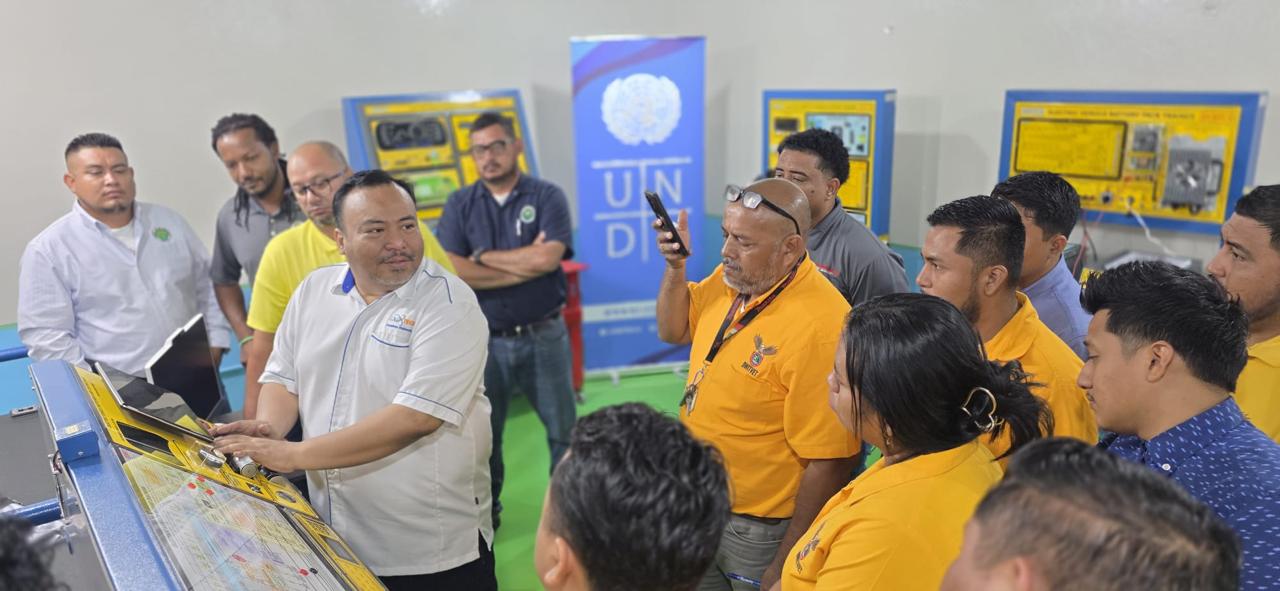
Close examination of the Operable Electric Vehicle Machine (Motor) Test Bed — exactly the hands-on access participants said was missing from their prior training.
This is what positions Labtech as a strategic implementation partner capable of converting government policy and donor funding into a functioning, self-sustaining technical capability on the ground — exactly the missing link that Belize’s e-mobility strategy required.
The Optimum Objective: A Replicable Model for the Region
The Orange Walk EV Laboratory’s significance extends well beyond the students who will pass through its doors. It exists to produce a self-sustaining, growing pool of certified technicians capable of installing, diagnosing, and maintaining electric vehicles and charging infrastructure across Belize — supporting the country’s existing electric bus fleet, its expanding public charging network, and the private EV adoption that is expected to follow. Just as importantly, it establishes a proof of concept for the wider region. UNDP and the European Union have positioned this laboratory as a flagship within the EU’s Global Gateway strategy for the Caribbean — a demonstration that a small nation, with the right funding partner, delivery partner, and technical training partner, can build first-of-their-kind technical capacity rather than wait for it. For neighbouring UNDP offices and Ministries across the Caribbean and Central America already exploring similar e-mobility investments, Belize now offers a working reference: a fully costed, fully delivered, publicly inaugurated model to replicate. For Labtech International, the optimum objective of this project was never simply to deliver four pieces of equipment to one classroom. It was to prove, once again, that the combination of purpose-built training systems, structured instructor certification, and genuine cross-sector engagement can turn a national policy commitment into an operational reality — in Belize first, and across the region next.
A Journey Just Beginning
As the ribbon was cut in Orange Walk on 8 July 2026, the achievement being celebrated was not only a new laboratory, but a new capability for an entire country — and a new regional benchmark for what EV technical training can look like when government, development partners, and technical training expertise align around a shared outcome.
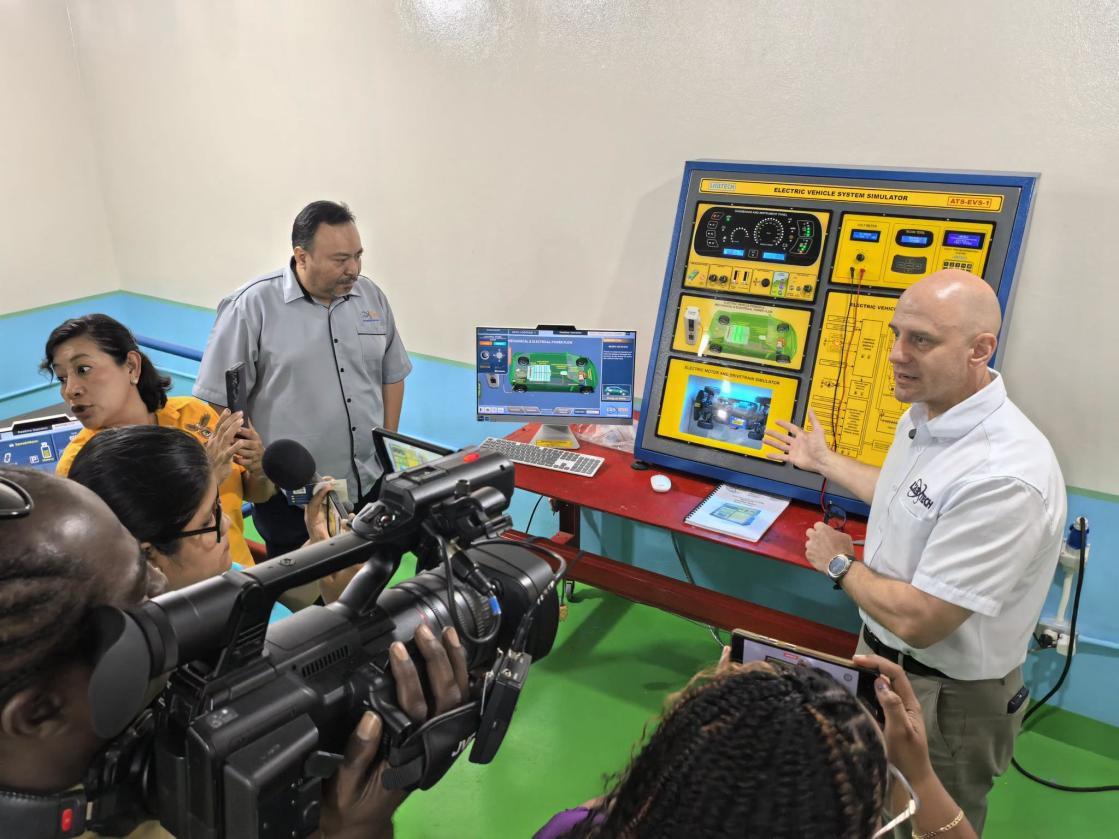
Labtech International walks local media through the Electric Vehicle System Simulator during the inauguration’s media interviews — carrying the story of Belize’s new EV lab to the wider public.
Labtech International is proud to have served as the technical partner behind this milestone, and looks forward to continuing this journey with the Government of Belize, UNDP, and the European Union — and to bringing the same model of hands-on, certified, real-world training to the next country ready to power up its own electric future.
